Mentioned by Academia
When academics start writing about a living artist, you might say that artist has achieved a certain amount of success – or infamy as the case may be. I’ve only just been informed that my work has recently been mentioned in two books I’ve not heard of until now. I received a brief but satisfying mention in American Studies in a Moment of Danger, by George Lipsitz, who is a professor of ethnic studies at the University of California, San Diego. Lipsitz writes about how the globalization of culture and commerce are impacting our ideas of national identity, and in part he uses an analysis of popular song lyrics, cinema, visual art and poster design to make his point that globalization is forcing “radically new understandings of politics, performance, consumption, knowledge, and nostalgia.”
In his book Lipsitz details how “Chicano artists gave broad exposure to international issues in their posters,” and mentions the contributions made by artists like Rupert Garcia, Malaquias Montoya, Linda Lucero, Herbet Siguenza, and Yreina Cervantes. These artists all created works that addressed topics from the Vietnam war and U.S. support for the Pinochet dictatorship in Chile, to the colonial relationship with Puerto Rico and intervention in El Salvador. Mentioning my work specifically, Lipsitz wrote, “Mark Vallen’s ‘Sandinista,’ and an unidentified artist’s ‘Poetry for Nicaraguan Resistance’ express solidarity with forces in Nicaragua under attack by the covert and overt support given to the ‘contras’ by the U.S. government.”
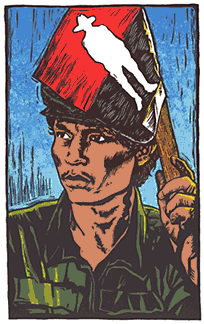
Mentioned in Professor Lipsitz’s, “American Studies in a Moment of Danger.” ]
The core point Lipsitz’s makes about early Chicano art is the following, “These posters demonstrate the simultaneous nationalism and internationalism of the Movimiento Chicano. Although the movement has often been caricatured (in retrospect) as a product of ‘identity’ politics, these posters show it to have entailed an intensely ideological effort to give an expressly political character to the term ‘Chicano.’ The internationalism, class consciousness, and solidarity with struggles for social justice among other aggrieved groups manifest in these posters reveals that the movement was an effort to convince people to draw their identity from their politics rather than drawing politics from their identity.”
My works were also acknowledged in Musical Ritual in Mexico City: From the Aztecs to NAFTA, by Mark Pedelty, who is an associate professor on the faculty of the General College at the University of Minnesota. Pedelty writes about how the past informs the present in Mexico, and how “one can also view the continued resonance of precortesian Mesoamerican music, rituals, and culture in contemporary indigenous communities.” The author also mentions how visual artists help make possible the reinvention, cultural reclamation, or preservation of indigenous Mesoamerica – and it is in that context that Pedelty mentions my works. “Mesoamerican images like this are constantly used as historical metaphors for and political tools against power in the present. Los Angeles artist Mark Vallen’s protest art is a prime example.”