Obey Plagiarist Shepard Fairey
The following are excerpts from Obey Plagiarist Shepard Fairey, a critique I wrote about artist Shepard Fairey on the occasion of his solo exhibition, opening Dec.1, 2007, at the Merry Karnowsky Gallery in Los Angeles. The full, unedited critique contains thirteen illustrated examples of plagiarisms committed by Fairey, three of which are shown in this web post. To view the complete exposé of Shepard Fairey, visit: www.art-for-a-change.com/Obey/index.htm
Excerpted article begins:
Most well known for his “Obey Giant” street posters, Shepard Fairey has carefully nurtured a reputation as a heroic guerilla street artist waging a one man campaign against the corporate powers-that-be. Infantile posturing aside, Fairey’s art is problematic for another, more troubling reason – that of plagiarism.
Plagiarism is the deliberate passing off of someone else’s work as your own, and Shepard Fairey may be unfamiliar with the term – but not the act. This article is not about the innocent absorption of visual ideas that later materialize unconsciously in an artist’s work, we do after all live in a maelstrom of images and we can’t help but be affected by them. Nor am I referring to an artist’s direct influences – which artist can claim not to have been inspired by techniques or styles employed by others? What I am concerned with is the brazen, intentional copying of already existing artworks created by others – sometimes duplicating the originals without alteration – and then deceiving people by pawning off the counterfeit works as original creations.
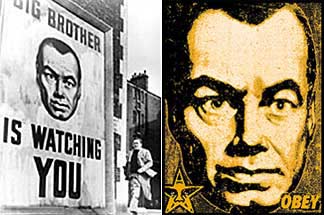
[ Left: Still from director Michael Anderson’s 1956 film adaptation of George Orwell’s cautionary story of a dystopic future, 1984. Right: Fairey unmistakably stole his image from the “Big Brother is Watching You” propaganda posters used in Anderson’s film, without crediting the source. ]
When the leader of the Communist Party of Czechoslovakia, Alexander Dubcek, began to implement a series of reforms in 1968, the Soviets feared a counterrevolution. Moscow sent tanks and troops to crush the so-called “Prague Spring“, but history means nothing to Shepard Fairey, who can strip an image of historic meaning faster than you can say “Czechoslovak Socialist Republic.”
During the opening days of the Soviet occupation, Czech patriots glued anti-invasion posters all over the walls of Prague, the nation’s capital. One daring but unidentified Czech artist created a street poster that portrayed the Red Army as liberators in 1945 – but oppressors in 1968. Fairey expropriated that poster and republished it as his own, inserting the words, “Make Art, Not War.”
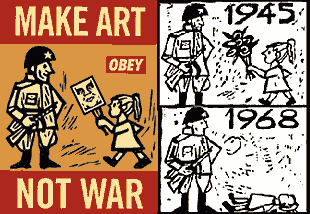
[ Left: Fairey’s plagiarized poster. Right: Original street poster from Czechoslovakia’s, Prague Spring – Artist unknown 1968. The poster depicts a Soviet Red Army soldier in 1945 as a liberator, then as an oppressor in 1968. ]
It goes without saying that Fairey has never mentioned the Czech poster he plagiarized, and since posters from the Prague Spring are virtually unknown outside of the Czech Republic, he has so far gotten away with calling this poster – like oh so many other works of his – an original design. Recontextualizing an image like the Prague Spring poster could afford an artist opportunities to reveal forgotten recent histories, linking them to current realities so as to produce instructive political insights. But all we get from Fairey is worn-out sloganeering and self-promotion. One can only wish that Fairey would take a cue from the clichéd catchphrase on his poster and “Make Art” himself instead of incessantly reframing and recycling the works of others.
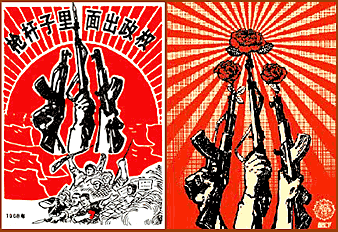
[ Left: Chinese poster from the Great Proletarian Cultural Revolution period. Artist unknown. 1968. Right: Fairey’s plagiarized version titled, Guns and Roses. The Chinese poster’s central motif of hands holding aloft machine guns was plainly digitally scanned without any alteration. Fairey, or his assistants, then applied a modified sun-burst background, placed clip-art roses in the gun barrels, and released the imitation as a supposed original work in 2006. ]
The expropriation and reuse of images in art has today reached soaring heights, but that relentless mining and distortion of history will turn out to be detrimental for art, leaving it hollowed-out and meaningless in the process. When I refer to “mining” in this case I mean the hasty examination and extraction of information from our collective past as performed by individuals who do not fully comprehend it. That is precisely what Fairey is guilty of, utilizing historic images simply because he “likes” them, and not because he has any grasp of their significance as objects of art or history. In 1916 Henry Ford, the famous American multimillionaire, bigot, and founder of the Ford Motor Company, uttered the infamous words, “History is Bunk.” That once outrageous statement has now become part and parcel of postmodern art, as reflected in Fairey’s own negligence regarding history.
If carefully examined, the rebellious patina and ersatz activism of Shepard Fairey’s art gives way to reveal little in the way of political imagination. Ultimately his work is the very embodiment of “radical chic,” bereft of historical memory and offering only feeble gestures, babbling incoherencies, and obscurantism as a challenge to the deplorable state of the world. Such an artist cannot provide us with a critical assessment of where we stand today.
_______
Please do not link to this web post, instead link to the complete article located at:
www.art-for-a-change.com/Obey/index.htm