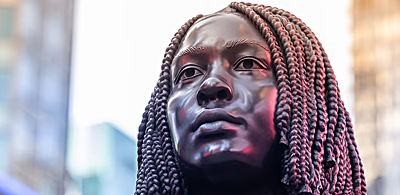
Category: African American

RATTLE Poetry Journal Cover Art

 vallen_rattle_cover

My oil painting, African American, appears as the cover art for the summer 2009 edition of Rattle, a journal dedicated to “Poetry for the 21st Century.”

One of the foremost poetry publications in the United States, Rattle has been publishing for 15 years. The “Tribute to African American Poets” edition will celebrate the work of 30 African American poets. You can order your copy directly from the Rattle website.

Charles White: Let The Light Enter

In April of 1967 the Heritage Gallery of Los Angeles published Images of Dignity, a monograph on the life and work of the great African American artist Charles White (1918-1979). I acquired a copy of the book just a year later when I was fifteen-years-old, the hardback volume providing one of my first insights into the works of White, American social realism, and the very idea of political engagement in modern American art. I have no hesitation in crediting White as a major influence in my life as an artist.

Opening this past January 10, and running until March 7, 2009, New York’s Michael Rosenfeld Gallery presents the important retrospective - Charles White: Let The Light Enter, Major Drawings, 1942-1970. The gallery’s biography on White opens with the following quote from the artist, which makes clear why he was such an influence upon me and why I continue to hold him in such high esteem:

“I am interested in the social, even the propaganda, angle in painting; but I feel that the job of everyone in a creative field is to picture the whole scene. . . I am interested in creating a style that is much more powerful, that will take in the technical end and at the same time will say what I have to say. Paint is the only weapon I have with which to fight what I resent. If I could write, I would write about it. If I could talk, I would talk about it. Since I paint, I must paint about it.”

I will mostly dispense with listing the biographical details and accomplishments of Mr. White since the artist himself wrote eloquently of his life and times in an autobiography that now appears on the Charles White Archive website. Instead I am going to focus on two aspects of White’s career that have considerable relevance to the present: his relationship to the Works Progress Administration in the U.S. during the Depression Era, and his connection to the socially conscious Mexican Muralist Movement of the same period - which has been another source of endless inspiration for me. In light of discussions on the possibility of there being a new federal arts program under the Obama administration, White’s overwhelmingly positive experience with the WPA provides food for thought, as does his having found common cause with the Mexican school of socially engaged art.

Drawing by Charles White

[ Awaken from the Unknowing - Charles White. Ink and Wolff crayon on paper. 1961. In this drawing White implores the viewer to read, knowing that literacy is essential to the people’s advancement. Image courtesy of Michael Rosenfeld Gallery.]

White was a 20-year-old living in Chicago, Illinois, when in 1938 he was employed by the Works Progress Administration and its Federal Art Project (FAP) Easel Painting Division, which was no small matter since until that time the young artist barely managed to survive by doing odd jobs - when he could find them. In a 1965 oral history interview conducted for the Smithsonian Institute’s Archives of American Art, White credited the FAP program with having enabled him to survive as an artist through very hard times. He also recognized the program for having expanded his range of artistic skills and knowledge, commenting that the FAP was “almost a school.” White said the following in his autobiography concerning having worked in the FAP:

“Looking back at my three years on the project, I see it was a tremendous step for me to be able to paint full time, be paid for it, although the pay was the bare minimum of unemployment relief. The most wonderful thing for me was the feeling of cooperation with other artists, of mutual help instead of competitiveness, and of cooperation between the artists and the people. It was in line with what I had always hoped to do as an artist, namely paint things pertaining to the real everyday life of people, and for them to see and enjoy. It was also a thrill for me to see so many accomplished artists at work, and to be able to learn from them.”

White eventually switched from the FAP’s Easel Division to its Mural Department, where he learned the basic skills needed to create monumental mural works. In 1939 FAP gave White the responsibility of creating a large mural for the Chicago Public Library. He chose for his mural the theme of outstanding African American leaders, and so painted Sojourner Truth, Frederick Douglass, George Washington Carver, Marian Anderson, and Booker T. Washington. Today the 5’ x 12’ oil on canvas mural hangs in the Law Library of the Howard University School of Law in Washington, D.C. Creating murals was a lifelong passion for White, and my home city of Los Angeles is blessed with the very last one he painted - a work produced in 1978 and located at the Dr. Mary McLeod Bethune Exposition Park Branch of the L.A. Public Library.

Here it is necessary to mention White’s relationship to the Mexican school - that fusion of muralism, printmaking, and easel painting driven by social concerns. “Los Tres Grandes”, the three greats of Mexican mural painting: José Clemente Orozco, Diego Rivera, and David Alfaro Siqueiros, had all visited the United States by the early 1930’s. In the wake of their U.S. visits they left behind a number of fabulous public murals, but also an enthusiastic network of American artists they had influenced through workshops, lectures, collaborations, and direct mentoring.

In 1941 White met and married Elizabeth Catlett, a remarkable artist in her own right. The two traveled to Mexico City in 1946, where they created prints with El Taller de Gráfica Popular (TGP - Popular Graphic Arts Workshop, founded in 1937), the foremost print collective in the country at the time. It was at the TGP that White learned the art of lithography, which became an enduring passion for him. At the workshop he met and worked with the likes of Diego Rivera, Pablo O’Higgins, and Leopoldo Méndez. In White’s own words, “One of the honors of which I am most proud is that of having been elected an honorary member of the Taller.” Catlett also did several of her most memorable prints while working at the TGP; and some of the collective’s prints, including works by Catlett and Méndez, made their way into Gouge - the Los Angeles Hammer Museum’s stunning exhibit on printmaking in the 20th century (now showing until Feb. 8, 2009).

Drawing by Charles White

[ Dreams Deferred - Charles White. Ink and Wolff crayon on paper. 1969. The title of this drawing refers to the 1951 poem by African American poet, Langston Hughes - What Happens to a Dream Deferred? Image courtesy of Michael Rosenfeld Gallery.]

During their sojourn in Mexico City, White and Catlett were invited to stay at the home of David Alfaro Siqueiros, where they lodged in the top floor of the muralist’s residence. White’s time in Mexico was revelatory, providing him the confirmation that his chosen path in art was the correct one to take. He felt kinship with the radical populism of the Mexican artists, whose fiery works embodied the very idea of social realism in art. White and Catlett would divorce in 1948: she stayed in Mexico for good, while he moved to New York City. There he began to associate with like-minded artists such as Antonio Frasconi, Leonard Baskin, Philip Evergood, William Gropper, Moses and Raphael Soyer, and other giants in American social realism. Eventually Mr. White settled in the city of Los Angeles, where he became an influential drawing teacher at Otis Art Institute.

What I always found so impressive about White was that he never abandoned his artistic vision in order to follow the dictates of what was fashionable. Despite the ascendancy and near total dominance of abstract art in the 1950s, followed by the successions of Pop, Minimalism, and all the vacuities of Postmodernism - White remained true to his style of figurative social realism. Part of his memoirs recount his lonely isolated struggle in the 50s against abstraction, of “going against the tide of what everyone was claiming to be ‘new’ and ‘the future’”, and we are all the richer for White’s perseverance.

But White’s courage went far beyond his flying in the face of what was trendy in the art world. He came to reject careerism in art, regarding celebrity as anathema to the higher ideals of art. The spirit found in the following passage of his memoirs should be held aloft as a banner by those artists and their supporters who ardently believe in art as a tool for social transformation;

“I no longer have my hopes and aspirations tied up with becoming a ’success’ in the market sense. I have had a measure of success in exhibits, some prizes and awards, although not as much as I might have gotten had there not been certain ‘difficulties’ presented by my speaking as part of the Negro people and the working class. Getting a marketplace success or recognition by art connoisseurs is no longer my major concern as an artist. My major concern is to get my work before common, ordinary people; for me to be accepted as a spokesman for my people; for my work to portray them better, and to be rich and meaningful to them. A work of art was meant to belong to people, not to be a single person’s private possession. Art should take its place as one of the necessities of life, like food, clothing and shelter.”

Charles White: Let The Light Enter, Major Drawings, 1942-1970, at the Michael Rosenfeld Gallery. January 10 - March 7, 2009.

A Black Panther in England

Black Panther: Emory Douglas and the Art of Revolution, opened at the Urbis exhibition center in Manchester, England, on October 30, 2008, and the exhibit will run until April, 2009. I first met Douglas in 2007 at his landmark retrospective held at the Museum of Contemporary Art (MOCA) in Los Angeles. I had the pleasure of talking with him again this past September at The African American Museum & Library in Oakland, California where he was exhibiting a work in a group show called, Banned & Recovered: Artists Respond to Censorship. I first learned of his UK show during our conversation in Oakland - a scoop I am pleased to announce on this web log.

Artwork by Emory Douglas

[ Offset color poster by Emory Douglas, former Minister of Culture for the Black Panther Party. In this circa 1970 poster, Douglas combined a double portrait of two lumpen proletarians with the lyrics to an old slave song, "Now all of us are soldiers, we have in our hands the freedom plow, and when we get old and can’t fight anymore, we gonna have to get up and fight anyhow." ]

At the time of this writing Douglas is in the UK, where he has received some significant press coverage. The Times published an article about him titled Emory Douglas paints American history black, and The Guardian published a piece under the headline, Fight the power. He was also interviewed by BBC Radio Manchester on October 18, 2008. The station maintains a website where you can listen to the interview (select the sound file titled “The People - For Manchester’s Black community“). The interview with Douglas appears some 17 minutes into the broadcast.

Blood: A Work in Progress

Oil painting by Mark Vallen

[ Blood - Mark Vallen. Oil on masonite. 18" x 24". Click here for a larger view. ]


A work in progress, my portrait of an anonymous African American man is intended as a rumination on racial politics in contemporary American society. The painting’s meaning and emotional focus is contingent upon who is viewing it, and while some may see menace, a great many others will perceive dignity. I have it in mind that my model’s unflinching gaze, the painting’s emotive color scheme, and the work’s very title - will all coalesce to form a challenging portrayal. While the work may seem finished to most, there are still a few painterly flourishes I wish to add.

The Revolutionary Art of Emory Douglas

The Museum of Contemporary Art (MOCA) in Los Angeles will be exhibiting, Black Panther: The Revolutionary Art of Emory Douglas, running October 21st, 2007 through January 20th, 2008. The exhibit takes place at the MOCA annex located at the Pacific Design Center in West Hollywood, California. Approximately 150 works created by Douglas while he was the Minister of Culture for the Black Panther Party will be on display, with the legendary artist scheduled to attend the special opening reception celebration to be held at the Pacific Design Center on Saturday, Oct. 20, 2007, at 6:00 pm. That event is free and open to the public.

Poster by Emory Douglas

[ Revolution in our Lifetime - Emory Douglas 1969 offset lithograph 20 ¼ x 14 in. One of the artist’s great iconographic images, this drawing appeared as a pull-out poster in the Black Panther newspaper, November 8th, 1969. ]


While the graphic art of Emory Douglas has been exhibited in many galleries over the decades, it is astounding to me that it is now being showcased in a museum as prestigious as L.A.’s Museum of Contemporary Art - especially considering the extreme rightwing political climate in the United States. To be truthful, I’m amazed this exhibit is happening at all. In describing the exhibit, MOCA declared; “At a time when political unrest, war protests, and social inequality have again reached a boiling point, but where artistic responses are not as easy to find, the work of Emory Douglas serves as a powerful reminder of the efficacy of visual art to communicate and push forward a political agenda.”

As a teenager in the late 1960’s, I was embroiled in the issues of the day, from the struggle to end the war in Vietnam to the countless attempts at uprooting and eradicating racism in the United States. I was a reader of the Black Panther Party newspaper, and like many other young people across the country, avidly collected the pull-out posters and graphics Douglas published in the paper. Unfortunately I’ve lost the bulk of my collection - but the fiery exhortations of those artworks remain forever burned in my memory. Numerous misconceptions are still held regarding the Panthers and their legacy, but to me their ideas were brilliantly represented in the artworks created by Emory Douglas. The MOCA exhibit offers a glimpse of recent American history that has become effectively buried and put out of mind - but it’s a history we cannot afford to forget.

Poster by Emory Douglas

[ Afro-American solidarity with the oppressed People of the world - Emory Douglas. 1969. This artwork originally appeared in the Black Panther newspaper, but was later reworked by the artist into this poster. ]


If I had to pick a single image by Douglas that exemplified Panther ideology - it would be the artist’s poster depiction of a young party militant, gun slung over shoulder, peddling a Panther newspaper bearing the headline, “All Power To The People.” That militant slogan best summed up the Panther political platform, but the axiom should also be seen as the core principal behind any genuine political democracy. The poster mentioned is the lead image displayed on the MOCA website, where nine images from the exhibition are on view.

At 3:00 pm on Sunday, Oct. 21, 2007, Emory Douglas will discuss with the public, the graphic art he created with the Black Panther Party. All are welcome to this free event. After the talk, Douglas will sign copies of his book - Black Panther: The Revolutionary Art of Emory Douglas. Instead of an official museum catalog, the exhibit will be accompanied by this book, which was published by Rizzoli in Feb. 2007. The book contains essays by Kathleen Cleaver, Bobby Seale, Amiri Baraka, Sam Durrant, and Danny Glover, along with dozens of full color reproductions of artworks and posters created by Douglas that originally appeared in the Black Panther Party newspaper.

MOCA’s Pacific Design Center gallery is located at; 8687 Melrose Avenue, Design Plaza G102, West Hollywood, California. 90069. Phone: 310-289-5223. Admission to the Emory Douglas exhibit is free.

The Builders & The Destroyers

Jacob Lawrence (1917-2000) was one of America’s greatest African American artists - but you could just as easily say that he was one of the preeminent artists of the 20th Century. There’s no doubt that his narrative style, a blend of social realism and flattened abstract picture planes, was to influence legions of artists - myself being one of them. His evocative and clear-headed works, while focusing on the adversity and privation endured by African Americans, spoke of oppression as a universal problem. Likewise, his series of artworks dealing with the likes of Toussaint L’Ouverture (The Life of Toussaint L’Ouverture) and John Brown (The Life of John Brown), unflinchingly focused a spotlight upon revolutionary violence as a way of ameliorating the worst outrages suffered by humanity. So I find it more than a little amusing that one of Jacob Lawrence’s paintings now hangs in the Bush White House.

The Washington Post reported on Sept. 20, that the Green Room of the White House has been freshly redecorated under the direction of First lady Laura Bush, and part of the renovation involved the placement of the painting The Builders, a newly acquired masterpiece created by Jacob Lawrence. In May of 2007, Christie’s sold The Builders at its auction of American Paintings for $2,504,000 - a world record price for a work by Lawrence. It was a privately funded department of the White House mansion’s historical association that purchased the painting.

The Builders - painting by Jacob Lawrence

[ The Builders - Jacob Lawrence 1947. Tempera on board, 20 by 24 inches. ]


The Post quoted Laura Bush’s comments regarding the painting, “I like the strength of it. It’s a very, very strong picture. The people in it are strong. He (Lawrence) liked the idea of a lot of people working together to build, I think that’s really just a picture of our country; that’s what our country relies on.” That remark might draw looks of stunned disbelief from the Katrina-ravaged people of New Orleans, but the irony is apparently lost on the First lady.

Black Heritage on the Auction Block

I was horrified to read in the Los Angeles Times that the historic collection of African American art owned by L.A.’s Golden State Mutual Life Insurance Company has been “carted off to be auctioned in New York.” The LAT article, Historians angered by auction of black art, revealed that “Golden State plans to sell 94 artworks Oct. 4 at Swann Galleries” in New York City, with the auction of paintings, prints, drawings and sculptures expected to sell for as much as $1.5 million. At issue here is not merely the desire to see this body of work remain in Los Angeles - much wider concerns are at stake.

As reported in the LAT, Samella Lewis, the founder of the Museum of African American Art in Los Angeles, stated; “It’s one of the finest collections in the West in terms of African American culture and art. It’s like a museum.” But an opportunity for L.A.’s museums to purchase the Golden State collection never occurred, as the insurance company decided to send all of the artworks straight to the auction block. How is it that we’ve arrived at a point in our so-called civilization where great collections of historic artworks can simply be sold off piece by piece to the highest bidders? What happened to civic pride and the public interest… where did they go? Clearly, the Golden State collection should be in a public museum and available in perpetuity to the general public.

But there’s another aspect to this story that bothers me a great deal. The significance of the Golden State collection reaches far beyond monetary worth - it represents a people’s collective history. From the Legend of John Brown series of screen prints by Jacob Lawrence to Charles White’s portrait of Harriet Tubman, the artworks epitomize, in visual terms, the African American struggle for justice and equality. How can such a body of work be scattered to the four winds, with individual pieces to disappear into private collections?

Portrait of Harriet Tubman by Charles White

[General Moses - Charles White. Ink on paper. 1965. White’s portrait of the escaped slave and leader of the famed underground railroad, Harriet Tubman, who was referred to as the Moses of her people. In the collection of the Golden State Mutual Life Insurance Company, but soon to be auctioned off to the highest bidder. ]


The LAT article quoted Paul von Blum, the senior lecturer in African American studies at UCLA, with a single sentence. “For the multicultural community in Los Angeles, it’s a cultural loss to the city. I would like to see these works go into a museum in Southern California.” Knowing Von Blum personally, and being acquainted with his deep and abiding passion for African American art, I realized he would have more to say on the subject, so I asked him to contribute his thoughts to my web log. Here’s what he had to say:

“On August 17, 2007, The Los Angeles Times published an article by Bloomberg News reporter Lindsay Pollock about the impending sale of the major artistic treasures of the Golden State Mutual Life Insurance Company in Los Angeles. This black-owned corporation plans to sell almost 100 artworks representing some of the most iconic figures in African American art history. Among the artists in this sale, to be conducted by Swann galleries of New York on October 4, are Henry Tanner, Romare Bearden, Jacob Lawrence, Charles White, Elizabeth Catlett, and David Hammons.

The loss of these works is nothing short of a cultural catastrophe for the Los Angeles area. During his 30 years as Golden State art director, Los Angeles artist William Pajaud lovingly assembled this collection, working with minimal funds and often trading his own paintings to acquire these artistic masterpieces. For almost two decades, I have conducted tours of this collection with my UCLA students and with numerous community groups. Without exception, visitors have been exceptionally moved by this collection. They have understood how the tradition of African American art serves as a reminder of the struggles, aspirations, and triumphs of people of African descent. Losing these works not only diminishes the status of the arts in Los Angeles, but also deprives generations of young people the opportunity to see and appreciate the accomplishments of such stellar African American visual artists.

A capitalist society provides little remedy against corporate sales of privately owned art collections. Still, people concerned about this impending cultural tragedy should alert area public officials and art world ‘players’ about what is about to occur. The best result, under the circumstances, would be for concerned area collectors to step in and purchase all (or at least many) of the works at auction and make arrangements to keep and display them publicly in Los Angeles. Such collectors, of all racial and ethnic backgrounds, exist in abundance in Los Angeles. Publicity about this sale can only in crease the likelihood that someone will rise to the occasion and save the Golden State art collection for the residents of Southern California.”

Our Flesh of Flames

Photomontage by Theodore Harris

[ Photomontage by Theodore Harris.]


Our Flesh of Flames is an incendiary exhibition of photomontage works by African American artist Theodore Harris, now showing at the Hammonds House Museum in Atlanta, Georgia, until September 9th, 2007. I’ve written about Harris before, and was tickled to see the positive write-up he received on Atlanta’s creativeloafing.com website. Here’s an excerpt of what reviewer Felicia Feaster had to say:

“As nitroglycerin-volatile as the title promises, Our Flesh of Flames is so provocative that it may be a good thing it’s tucked away on a leafy, serene street in the West End. Philadelphia artist Theodore Harris’ collages and collage-based prints suggest a newspaper cut up and culture-jammed by a punk-rock revolutionary. Instead of journalistic ‘objectivity,’ there is subjective fury. It’s a rage directed at a country underpinned by big money and the sedative appeals of God and country. In Harris’ work, it’s not Iraq that’s the war zone; it’s America.

Harris’ repeated visual motif is the provocative image of the U.S. Capitol turned upside down like an inverted cross. Mixed in with that vision of a country whose cherished democracy has essentially gone belly-up are images of raging fires, hooded Klansmen, Bubbas waving Confederate flags, police cracking batons on civilian heads, dripping blood, wounded American soldiers, helicopters and demolished buildings. (….) Our Flesh of Flames is a welcome change from a larger culture of apathy.”

Concurrent to the Hammonds exhibit of Harris’ works, the museum is also showing a selection of political posters created by African American artists during the heyday of late 60’s activism. Of particular note are the many original works on display by Emory Douglas, the former Minister of Culture of the Black Panther Party.

By the way, the works of Emory Douglas will also be exhibited at the Pacific Design Center in Los Angeles, California, starting October 21st, 2007 and running until January 20th, 2008. It is an exhibit that I will undoubtedly be covering extensively on this web log. Approximately 150 works by Douglas will be on display in the exhibition organized by L.A.’s Museum of Contemporary Art. Instead of an official museum catalog for the show, the exhibit will be accompanied by the fantastic book, Black Panther: The Revolutionary Art of Emory Douglass, published by Rizzoli in Feb. 2007.

“Malcolm X Speaks for Us”

If he had not been struck down by assassins on Friday, May 19th, 1965 - Malcolm X would be celebrating his 81st birthday with us today.

Linoleum cut by Elizabeth Catlett

[ Malcolm X Speaks for Us - Linoleum cut by Elizabeth Catlett, 1969. ]


In 1969 African-American painter, printmaker and sculptor, Elizabeth Catlett, paid tribute to the slain freedom fighter with her linoleum cut, Malcolm X Speaks for Us. Though she had moved to Mexico in 1947, making that country her permanent home, she still kept a close eye on the Black liberation movement in the United States. Using the linoleum cut method of printmaking, a technique Catlett became accomplished at while working with Mexican artists at the famed Taller de Grafica Popular (People’s Graphic Arts Workshop), the artist created an evocative visual statement regarding the militant leader’s legacy. African-American men credited Malcolm X for having given them their manhood back, but in Catlett’s print all of the faces surrounding Malcolm are female. It was the artist’s way of saying that Black women too had found their pride through the thoughts and actions of Malcolm X.

Farewell Brother Crichlow

Ernest Crichlow spent his entire artistic career painting and drawing the African American experience. He was involved in the 1930’s Harlem Renaissance, worked in the Federal Art Project as part of the Great Depression era Works Progress Administration, and in 1942 was an exhibiting artist in New York City’s very first exhibit of Black American artists - a show that included Romare Bearden, Jacob Lawrence and Norman Lewis. Crichlow’s art was rooted in social realism, and he was never afraid to tell the truth about American life. But through is artworks he also provided beauty, vision and hope to his beleaguered people.

The Lovers - Lithograph by Crichlow

[ The Lovers - 1938 Lithograph. Crichlow’s depiction of a Black woman being raped by a Klansman was created when the KKK was very strong in the United States. The artist never avoided controversy, and his social realist style caused him to confront many uncomfortable realities.


In a 2003 interview with CounterPunch Magazine, Crichlow said; "I never say 'art,' I say 'life' because that's what my art is. It's everybody's art whether they realize it or not. That's what art is, it belongs to everyone. But one thing I do think that is really important is that your art reflects what is important in your life. Whether you are a writer or a musician or a painter, where are you getting your creativity from? What I mean to say is that I don't think [modern students] see it as part of their life. They have a tendency to separate. Like ‘this is what I do for a living,’ as opposed to ‘this is my life.’”

Ernest Crichlow passed away on November 10th, 2005, at the age of 91. In singing his praises I’d like to make note of his passion for art and how he never allowed that fervor to wither in the face of adversity - a strength every artist must strive for in these trying times. For his dedication and enthusiasm, his tenacity and skill, my eulogy to Brother Crichlow ends with a salute, and the following words for those painters everywhere who mourn the passing of great artist- live like him.