Art and the Global Economic Meltdown
An unavoidable political topic is on the lips of everyone in the art world these days, I am not speaking of the U.S. presidential election – but of an international economic meltdown the likes of which we have not seen since the Great Depression of the 1930s. No matter what “new” political circumstances we wake up to in the aftermath of election day, the reality of economic disintegration will still be staring us in the face.
That fact will be shaping the world of art from top to bottom for many years to come, raising some important questions that artists will have to meet head-on, not the least of which is, how will artists be able to sell their works – an already difficult process – under the extremely tough conditions imposed by an economic catastrophe?
A number of artists have already begun responding to the crisis. Artist Geoffrey Raymond has been painting large “annotated” portraits of the powerful individuals involved in the Wall Street crash, men like Federal Reserve chairman Ben Bernanke and former Lehman Brothers chief Richard Fuld, setting the portraits up on Wall Street and allowing the public to scribble their remarks directly on the paintings. Printmaker and painter Laura Gilbert also brought her art to Wall Street, passing out signed and numbered “Zero Dollar” prints outside of the New York Stock Exchange.
The imitation dollar bills display a zero instead of the numeral one. Gilbert said her prints were a comment on “the destructive role of many financial institutions, inflation and the decline of U.S. currency to the point of seeming worthlessness.”
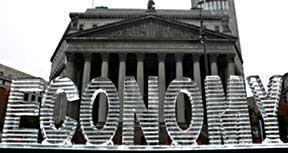
On October 29, 2008, the 79th anniversary of the stock market crash that heralded the Great Depression of 1929, artists Nora Ligorano and Marshall Reese set up a piece of installation art close to the heart of Wall Street. Using the New York Supreme Court building as a back drop, the Ligorano/Reese installation consisted of giant blocks of ice carved into letters that together spelled, ECONOMY. Titled Main Street Meltdown, the 15 foot long, 5 foot high, 1,500 pound ice sculpture was allowed to thaw on the street amongst the bustling crowds of bewildered Wall Streeters. Ligorano/Reese stated on their website; “To see the word ‘economy’ melting down is representational of an extreme time.”
At the same time I maintain that much more needs to be done to extricate art from its current impasse. Artists must become socially engaged and cognizant of world realities if we are to produce profound and lasting works of art for the 21st century. The quandary faced by contemporary artists coping with economic breakdown also extends to the gallery system and elite art institutions. In her Oct 19, 2008 article for the New York Times, Museums Fear Lean Days Ahead, art critic Carol Vogel wrote that museum directors across the country are…
“…bracing for the effects of an economic crisis that could change everything from the size and kinds of exhibitions a museum presents to the acquisitions it could afford and the merchandise it should offer in its shops.
Already the financial-market meltdown has diminished the endowment funds that cover museums’ day-to-day operating expenses. Lehman Brothers, for years a crucial sponsor for museums across the country, is no more. Surviving banking institutions and corporations that also have been the bedrock of exhibition support are likely to give far less or cut off gifts altogether.”
In his Oct 24, 2008 article for New York Magazine, Frieze After the Frieze, art critic Jerry Saltz noted the mood at the recent London Frieze Art Fair – and by extension, the temper of the elite art world in general. Saltz wrote the following:
“As I made my way through the 152 booths, I thought about the moment in Titanic when the designer of the doomed luxury liner warns Kate Winslet to find a lifeboat because ‘all this will be at the bottom of the Atlantic.’ (….) Recessions are hard on people, but they are not hard on art. The forties, seventies, and the nineties, when money was scarce, were great periods, when the art world retracted but it was also reborn. New generations took the stage; new communities spawned energy; things opened up; deadwood washed away. With luck, New Museum curator Laura Hoptman’s wish will come true: ‘Art will flower and triumph not as a hobby, an investment, or a career, but as what it is and was—a life.'”
Saltz’s article touched upon a belief that I have long held, that great art comes from trying and chaotic times. It behooves today’s artists to study the life and works of those painters who lived through the Great Depression of the 1930s, such scrutiny can perhaps serve as a starting point for our own responses to a world beset by economic wrack and ruin. But we cannot hope to simply replicate, both figuratively and literally, the works of those artists who preceded us. We must concoct our own aesthetic responses to meet the challenges of the present.