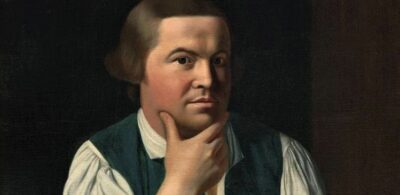
Thomas Crawford and his Statue of Freedom
After his January 20, 2025 inauguration, President Trump addressed the nation in a speech he delivered at Emancipation Hall in the US Capital Visitor Center. If you watched the oration you may have noticed the huge sculpture in the background—what does it portray? Allow me to share the details.
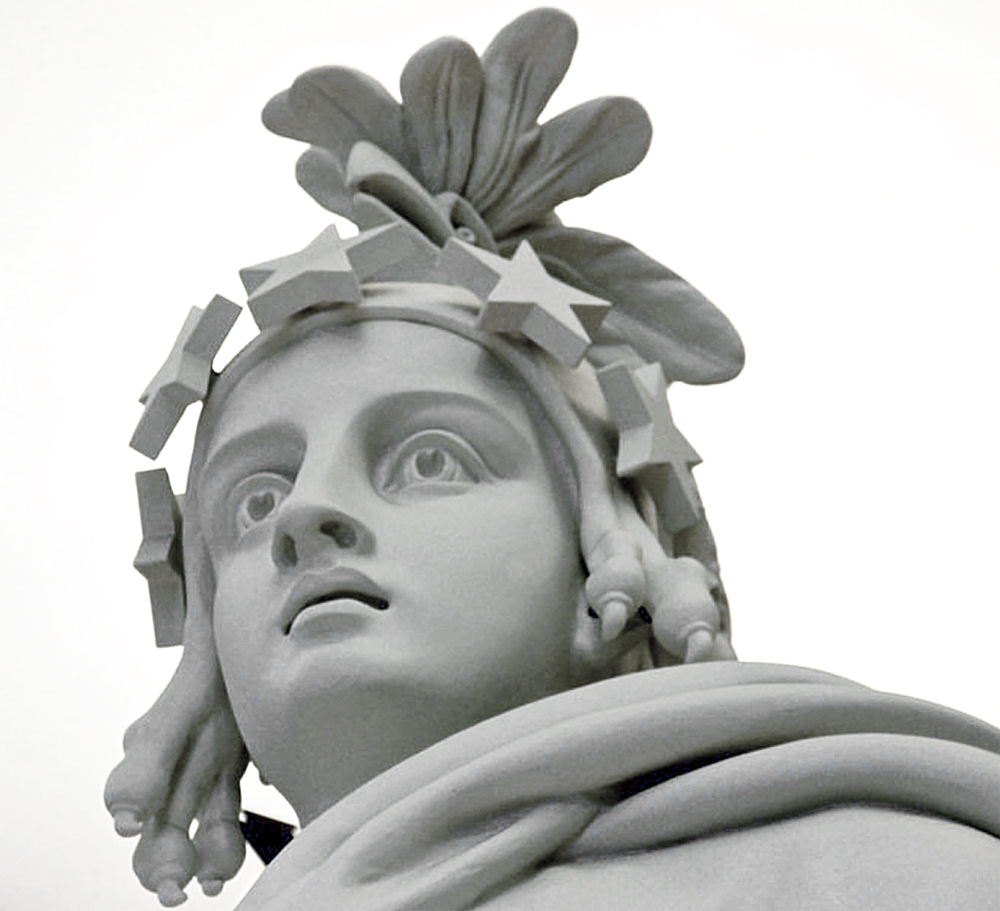
Today, many think the statue depicts a Native American, that’s close but not very accurate. In 1854 the US Congress commissioned American artist Thomas Crawford (1814-1857) to create a bronze statue that would sit atop the dome of the US Capitol building, which was then under construction. The artist titled his statue, “Freedom Triumphant in War and Peace.” He said the statue represented “Armed Liberty.”
Crawford’s sculpture depicts an allegorical female that bears a resemblance to Bellona, ancient Roman Goddess of war—since she holds a sword, shield, and wears a Roman style military helmet. But there the resemblance ends, Crawford wanted to champion an American theme and aesthetic.
Crawford said the helmet’s crest, “which is composed of an eagle’s head and a bold arrangement of feathers,” suggested “the costume of our Indian tribes.” The earflaps of the helmet are the eagle’s taloned feet. The woman is wrapped in what could be seen as a buffalo robe. Her tunic is held together by a brooch engraved with the letters, “US.” Her shield is emblazoned with the stars and stripes.
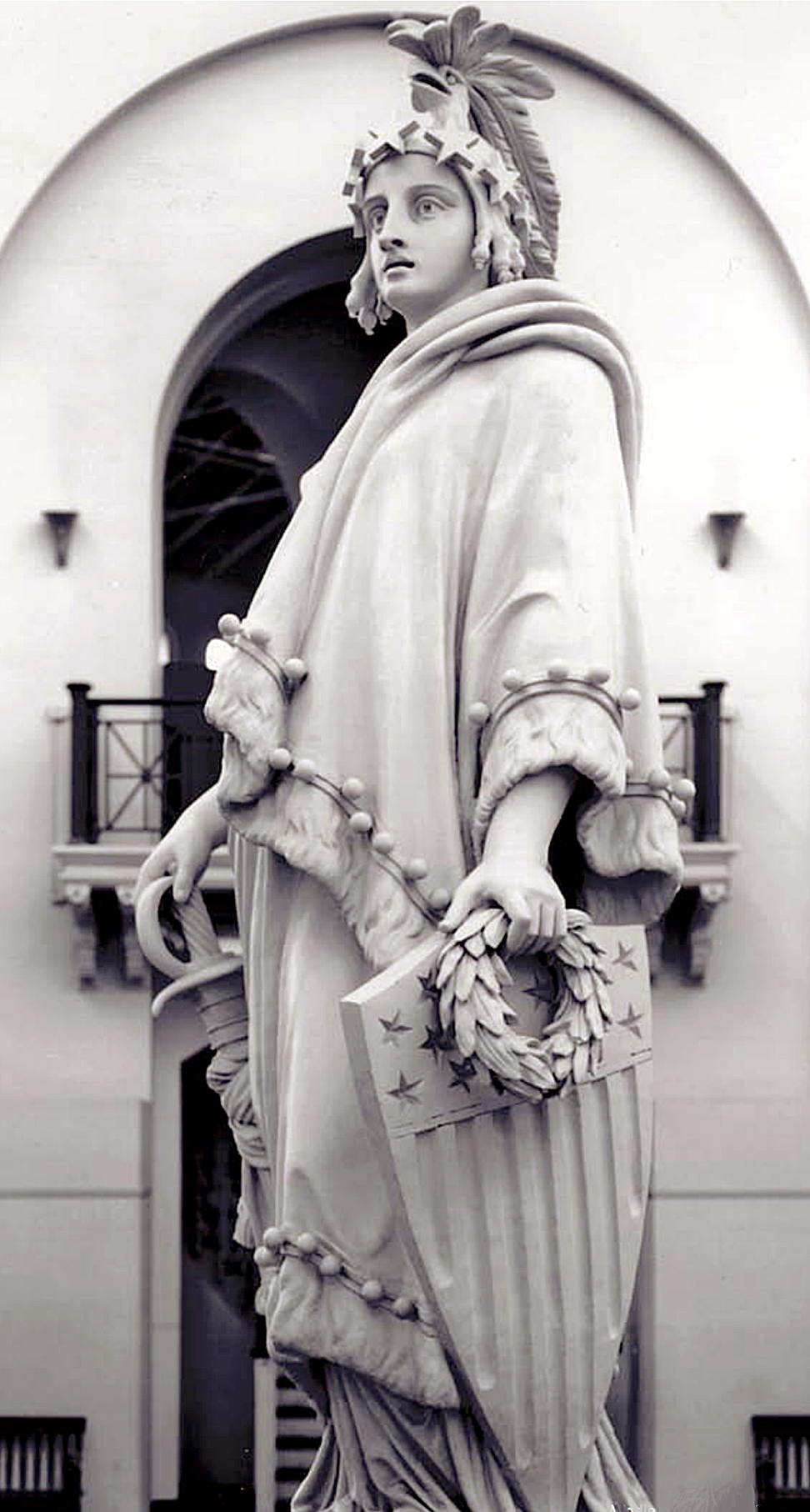
It may escape modern city dwellers, but many white Americans in the mid-1800s viewed indigenous plains people as wild and unfettered. Crawford likely saw them as instinctively freedom loving, and so incorporated them symbolically into his liberty extolling statue. This was part of America’s developing, independent visual language.
Before the Civil War (1861-1865), foundries in the US that were proficient in casting bronze were few. In Europe the complex and age old “lost wax” method was used to create highly detailed bronze artworks—but this technique was still not feasible in America. To produce his statue Crawford used the “sand casting” method, which had been in use since 1818. He began his sculptural project in 1854 by completing a large plaster sculpture that stood 19 feet, 6 inches.
Crawford died of cancer in 1857 at the age of 43, never to see his artwork cast in bronze. In 1860 his plaster model was beginning to be cast in bronze at the foundry near Washington D.C. established by American sculptor Clark Mills. However, the process was interrupted when the Civil War erupted in 1861.
Crawford’s plaster model had to be cut into separate pieces in order to make the sand molds, the parts were then cast in bronze, and the individual castings were welded together with bronze to complete the final sculpture.
By 1863 the dome on the Capitol building was nearly completed, and Crawford’s finished bronze statue was seated at its summit. The monumental bronze has been there ever since. Today the statue is formally known as the “Statue of Freedom.”
Because Crawford’s original plaster model had been cut into pieces, artists skillfully reassembled it using fresh, wet plaster. For a time the renewed plaster model was displayed in cramped, poorly lit museum galleries, but mostly it was kept in institutional storage for decades.
Ultimately in 2008, the historic “Statue of Freedom” plaster statue found a home in the US Capital Visitor Center’s Emancipation Hall, where over 2 million people a year can admire its beauty and profundity. I’m certain the spirit of Thomas Crawford is honored.