


Back To The Futurists

The Italian Futurists had an obsession with all things modern, the city, the automobile, the plane. They turned their backs on the past and set their sites on the technological future, hence their name. Their mania for speed, whether that of a fast moving car or a diving plane, was based upon a veneration of technology; they even came to identify the din of the city as “The Art of Noise,” the mechanical world’s equivalent to bird song and the babbling brook.
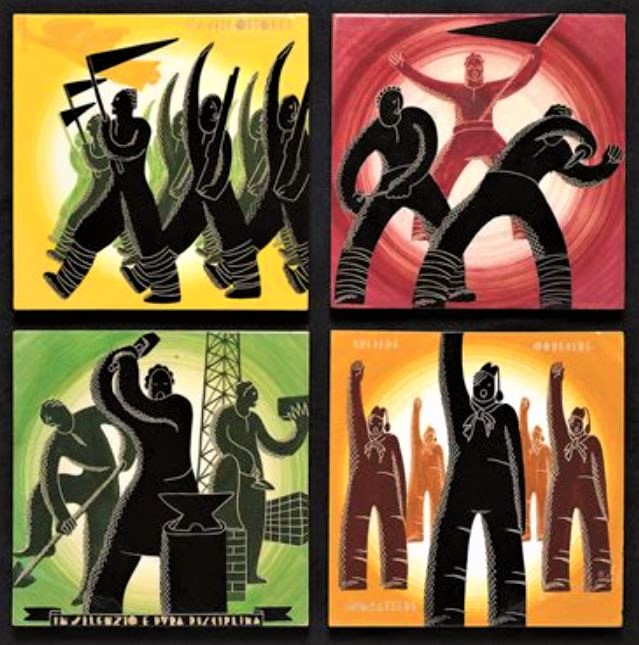
Futurist ceramic tiles by Corrado Cagli and Dante Baldelli (1931) depicting Mussolini’s rise to power.

Now a new Italian museum, The Wolfsoniana, presents a major collection of Futurist works consisting of some 20,000 objects and 17,000 documents; which includes an original copy of “The Futurist Manifesto,” the influential proclamation written in 1909 by the movement’s founder, Filippo Tommaso Marinetti.

However, while the Futurist vision of a machine world was brilliantly expressed aesthetically, it was doomed to ultimate failure because it was coupled with fascist ideology. Marinetti’s angry manifesto heralded a new art movement but also prefigured the fascist takeover of Italy. In his original statement Marinetti proclaimed, “We want to glorify war – the only cure for the world.”
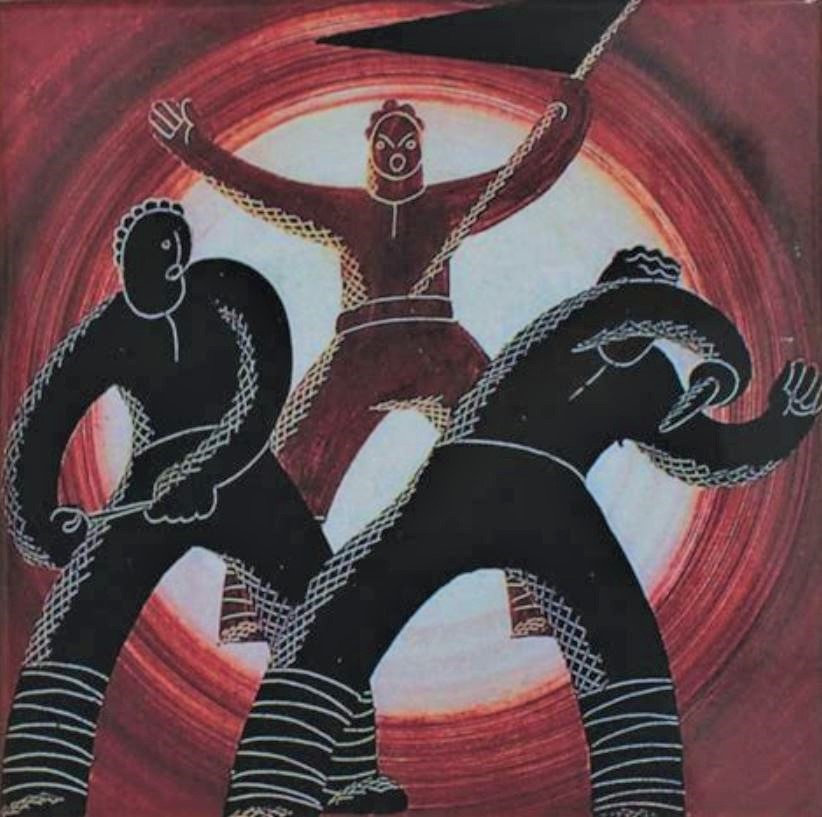
Detail of tile by Corrado Cagli and Dante Baldelli.

In retrospect it’s easy to be dismissive of the Futurists for their close connections to Benito Mussolini, but their rhetoric was remarkably similar in tone to things I hear and read today.

How is our current infatuation with technology any different than theirs? It begs the question, “How do you know you are not a fascist?” Perhaps we’ll find the answer by studying the Wolfsoniana collection of artworks prompted by Italy’s bygone totalitarians.
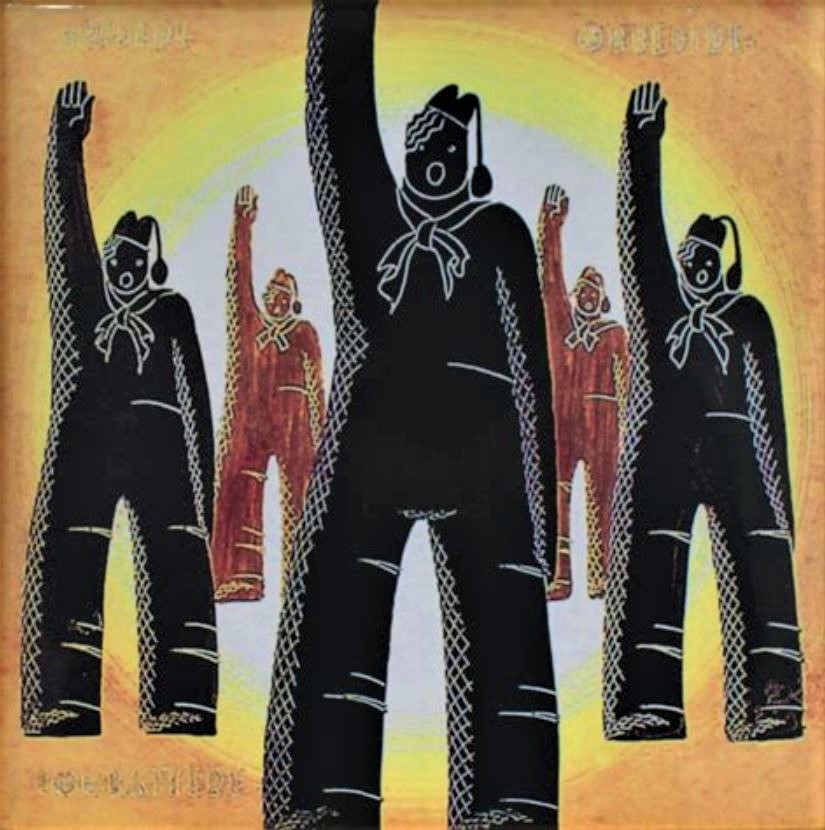

Detail of tile by Corrado Cagli and Dante Baldelli.

Similar Posts

  • John Lennon and I

    The political activist side of John Lennon seems to have been largely dismissed or forgotten by the general public, and corporate media reports on the anniversary of his murder are not likely to mention anything more controversial than Beatlemania. Obviously Lennon had an enormous impact upon my generation, setting us free with the primal rhythms and energy of rebellious rock…

  • An Odd, Groaning Civilization

    “People are crushed under the wardrobe. Without lifting up the wardrobe it is impossible to deliver whole peoples from their endless and unbearable suffering. It is terrible that even one person should be crushed under such a weight: to want to breathe, and not be able to. The wardrobe rests on everybody, and everyone tries to lift up the wardrobe,…

  • Body Worlds: The Art of Plastic Corpses?

    In 2004 the California Science Center in the Exposition Park of Los Angeles, presented Body Worlds: The Anatomical Exhibition of Real Human Bodies. In the words of the museum, “Thanks to the breakthrough process of plastination, more than 200 real human specimens are displayed to reveal an extraordinary new look inside the human body.” As a realist artist I naturally…

  • Yue Minjun: Execution

    At London’s Sotheby’s auction house on Oct. 12, 2007, just as Execution, a painting by contemporary Chinese artist Yue Minjun was about to go on the auction block, a man seated in the auction hall leapt to his feet and began shouting; “Shame on all of you! You’re spending millions of pounds on art and the world is falling apart!…

  • Abstract Art & The Cultural Cold War

    For those who still regard art as being above politics consider the following. The Central Intelligence Agency financed, organized, and assured the success of the American abstract expressionist movement, using artists like Jackson Pollock, Sam Francis, Willem de Kooning, Barnett Newman, Robert Motherwell, and Mark Rothko, as weapons in the struggle against the Soviet Union. Frances Stonor Saunders has presented…