
|

Nagasaki Nightmare

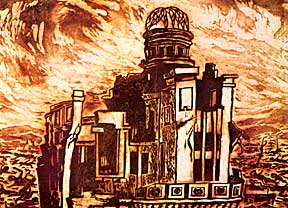
Evening glow over Hiroshima - Woodblock print by atom bomb survivor, Asai Kiyoshi
“Evening Glow over Hiroshima.” Asai Kiyoshi. Woodcut print.

August 6th, 2005, marks the 60th anniversary of the atomic bombing of Japan. August 9th, marks the bombing of Nagasaki.

Those who survived the blasts became known as hibakusha (Atom Bomb Survivors), and in 1974 the hibakusha began contributing artworks to an unusual project that would preserve for the world their memories of atomic fire.

The Nippon Hoso Kyokai (NHK – Japan Broadcasting Corporation), encouraged hibakusha to submit original artworks based on personal experiences of having survived the nuclear bombings. Soon thousands of drawings, paintings and woodblock prints began arriving at the offices of NHK, and an exhibition of the collected paintings and drawings was mounted at the Peace Culture Center of Hiroshima in 1975.

In 1984 I had the distinct honor of organizing an exhibition of these remarkable paintings in an exhibit I curated at a venue in Venice California. I received some 30 images from Japan that had at the time, rarely been seen in the United States.

Since then the NHK/hibakusha artworks have been compiled into several books and traveling exhibitions. To commemorate the first, and hopefully last atomic war, I’ve recently expanded the archive of hibakusha artworks I maintain on my Art For A Change website.
Similar Posts

  • |

    Gustav Klimt: At The Getty

    I had the good fortune to see Gustav Klimt: The Magic of Line, at the J. Paul Getty Museum of Los Angeles, California. It is the first exhibition devoted exclusively to the drawings of the Austrian painter and leading member of the Vienna Secession movement. Marking the 150th anniversary of Klimt’s birth, the Albertina Museum of Vienna, Austria, loaned over…

  • Body Worlds Corpse Factory

    On January 29, 2005, I wrote about Body Worlds being one of the most popular exhibits ever to have been presented at The California Science Center in Los Angeles’ Exposition Park. Body Worlds is hailed as art by some, and was conceived by Gunther von Hagens. His “artwork” consists of actual human bodies that have been injected with molten plastic…

  • Goya and the Sleep of Reason

    In the late 1700s the Spanish artist Francisco de Goya y Lucientes (1746-1828) created a series of eighty etchings he titled Los Caprichos (The Caprices). An irrational thought or action can be a “caprice,” and Spanish society at the time provided Goya with myriad examples of ferocious caprices. For instance, Goya created paintings and prints that wryly scrutinized the Spanish…

  • Yue Minjun: Execution

    At London’s Sotheby’s auction house on Oct. 12, 2007, just as Execution, a painting by contemporary Chinese artist Yue Minjun was about to go on the auction block, a man seated in the auction hall leapt to his feet and began shouting; “Shame on all of you! You’re spending millions of pounds on art and the world is falling apart!…